


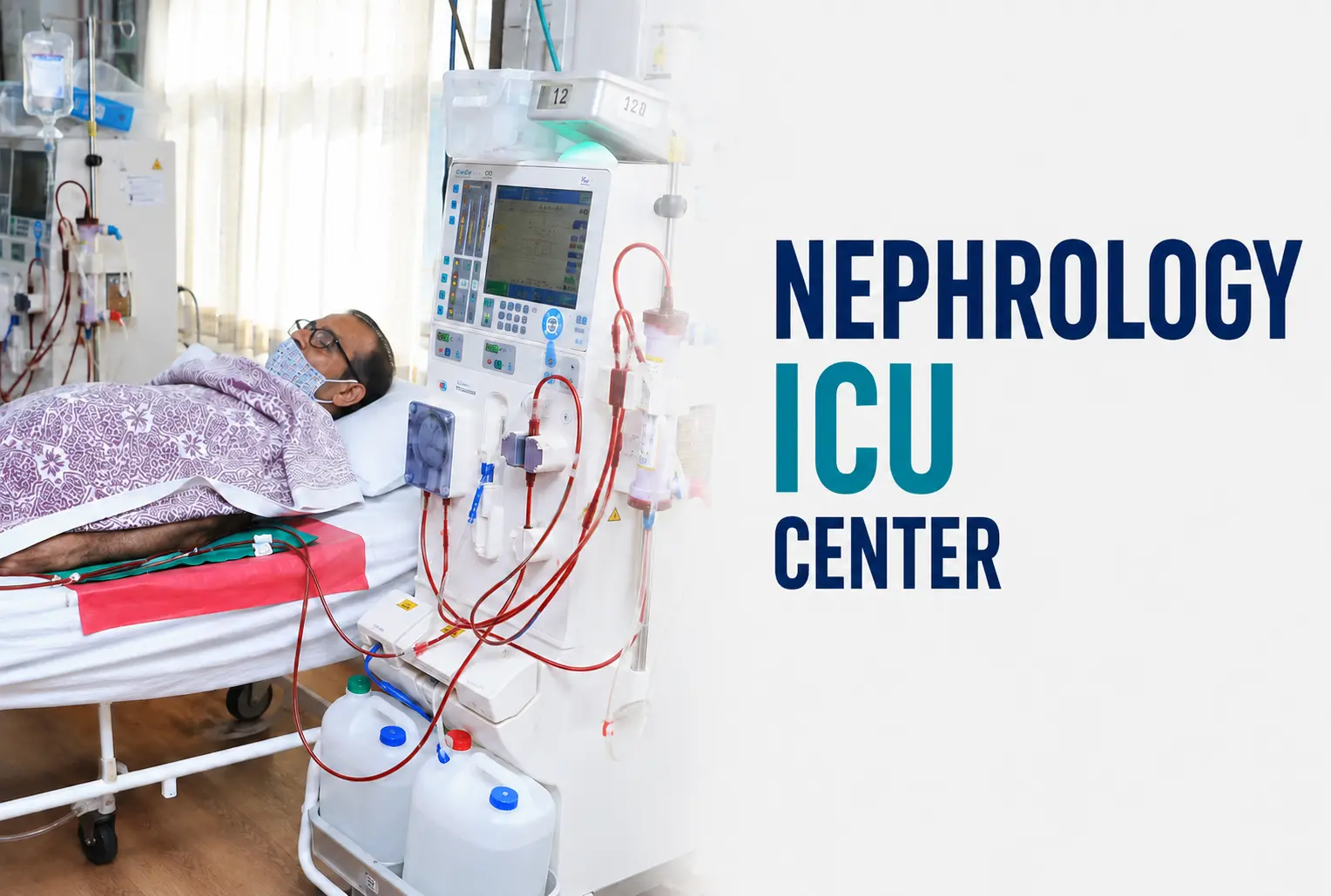
Kidney disease can turn life-threatening fast, and when it does, patients need people who know both sides of it, kidney function and critical care. Not one specialist for each. If you're searching for a Nephrology ICU in Ahmedabad, timing is really what decides the outcome here. Get treatment started right away, and there's a real chance to stabilise the patient, catch complications before they spiral, and actually recover.
Kidney Cure Hospital runs a dedicated kidney intensive care unit for exactly this kind of situation, severe kidney disease, acute kidney injury, kidney failure, sepsis, and other critical conditions. Nephrologists and intensive care specialists work the same cases together here, round the clock, ready to move fast when something changes.
An intensive care unit built specifically for patients with severe kidney problems. That's the short version. It combines critical care expertise with kidney-specific treatment in one unit, under one team.
A general ICU isn't built the same way. This one exists for patients whose kidney function has suddenly dropped, or who've developed complications on top of existing chronic kidney disease, and these cases often need several things running at once: continuous monitoring, emergency dialysis, careful fluid management, correction of dangerous electrolyte imbalances.
Go with a hospital that has a dedicated Renal ICU in Ahmedabad, and kidney emergencies get handled by people who actually deal with this complexity every day.
Sometimes kidney disease crosses a line. It starts affecting other organs. It becomes a threat to life, not just to kidney function. That's the moment intensive care needs to start, and starting early tends to mean better outcomes and fewer complications later.
A nephrologist might recommend ICU admission for:
None of these is things a regular hospital ward is equipped to handle. They need kidney critical care, and they need it continuously.
Patients with severe kidney conditions, needing fast, specialised support, that's who this care is built around. Every plan gets shaped by the individual's overall health and how their kidneys happen to be functioning that day.
Who ends up admitted, most often:
Sudden emergencies. Complex, layered kidney disorders. Our ICU for kidney patients in Ahmedabad is set up to handle both.
A wide range of kidney emergencies, plus whatever critical medical conditions come along with them, that's the daily reality of a nephrology ICU. Treating it all early is what keeps kidney damage from becoming permanent.
Conditions we see often:
No two treatment plans look identical. Each one gets built around the specific patient and how they respond as things move forward.
Stabilise first. That's always step one. From there, the focus shifts to supporting kidney function while treating whatever caused the failure in the first place, and constant monitoring means the team can react the second something shifts, not hours later.
Treatment may include:
Managing the kidney failure itself is only half the job. Protecting every other organ from fallout matters just as much.
Some patients genuinely can't wait. Waste builds up. Fluid builds up. Electrolyte levels swing dangerously fast. In those moments, emergency dialysis isn't optional, it's often what keeps a bad situation from becoming a fatal one.
When kidneys suddenly stop working, or toxins build up in the blood faster than expected, ICU Dialysis becomes part of the plan for patients already admitted.
Emergency Dialysis here covers:
Nephrologists and dialysis specialists aren't on call here, they're already present, which is exactly why treatment can start the moment it's needed.
While the medical team works on the underlying illness, kidney support therapy takes over some of what the kidneys can't do on their own for the time being. It's a core piece of keeping critically ill patients stable.
Depending on the case, treatment might involve:
Nothing here is generic. Every plan tracks closely with the patient's condition and where their recovery is actually heading.
Severe kidney disease can turn a corner fast, and not always for the better. That's the entire reason continuous monitoring exists in this unit, catching a complication the moment it starts, rather than after it's already done damage.
Our ICU team keeps constant watch on:
Kidney emergencies don't wait around, and treatment shouldn't either. Every hour of delay raises the risk of permanent kidney damage, sometimes worse. A nephrologist needs eyes on the patient fast.
Get emergency care if you notice:
Our 24-hour nephrology emergency services in Ahmedabad are ready the moment a patient walks in, no waiting for a scheduled slot.
Critically ill kidney patients need more than a bed and good intentions. They need nephrologists who've actually seen these cases before, real ICU infrastructure, and monitoring that never really stops. That combination is what makes faster, more specialised care possible in a genuine emergency.
Patients choose us as the Best hospital for nephrology ICU in Ahmedabad for reasons like:
Safe, evidence-based treatment stays the priority throughout. So does standing by the patient's family through what's often a genuinely hard stretch of time.
In a kidney emergency, every minute counts. Our dedicated Nephrology ICU team is ready 24/7 to provide advanced critical care, emergency dialysis, and constant monitoring when you need it most.
An intensive care unit built for patients facing severe kidney disease or kidney emergencies, constant monitoring, expert-level treatment, nothing generic about it.
Anyone dealing with acute kidney injury, kidney failure, severe infection, electrolyte imbalance, or other complications serious enough to threaten life.
A Renal ICU zeroes in specifically on kidney conditions, run by nephrologists working alongside critical care specialists rather than a general team covering everything.
Yes, for patients who need waste, excess fluid, or dangerous electrolyte levels removed without delay.
Yes, and quite often successfully, especially when it's caught early and monitored closely from the start.
Kidney failure, severe dehydration, high potassium, fluid overload, sepsis, sudden kidney function loss, all of these count.
It is. The monitoring is closer, and it's usually happening alongside other serious medical issues the team is managing at the same time.
Depends entirely on the case. A few days for some, considerably longer for others, based on how the kidneys respond.
It varies with the patient's condition, length of stay, investigations needed, dialysis requirements, and medications involved. A proper estimate usually comes after evaluation, not before.
The moment you notice a sudden drop in urine output, severe swelling, breathing trouble, confusion, or persistent vomiting, don't wait it out.
Copyright © 2023 Kidney Cure Clinic & Dialysis Center. All Rights Reserved | Develop by Nexus